
Science of screen printing reveals how ink, mesh, and emulsion interact to produce durable, vibrant images on fabrics and other substrates. It blends art and science, connecting pigment chemistry with material physics across every press run. A solid grasp of screen printing ink types, screen printing mesh count, and emulsion chemistry helps you predict ink laydown, sharp lines, and washfast results. Understanding emulsion exposure and curing ensures the stencil remains durable through multiple color layers. By tying these concepts to the screen printing process steps, you can optimize each job from design to finished garment.
Viewed through a materials-science lens, the craft becomes a story of how chemistry, physics, and practical technique come together in each print. Rather than treating ink, mesh, and emulsion as separate parts, this perspective emphasizes how ink systems, stencil creation, and exposure controls interact to shape results. This LSI-informed framing introduces related terms such as ink formulations, mesh choices, emulsion performance, exposure control, and the stepwise workflow that guides production. By focusing on these interconnected ideas, printers can diagnose issues, iterate efficiently, and deliver consistent, high-quality outputs across substrates.
Science of screen printing: ink types and substrate interactions
At the core of the science of screen printing is ink formulation. When we talk about screen printing ink types, we’re considering categories like water-based inks, plastisol inks, discharge inks, UV-curable inks, and hybrid blends. Each type carries a distinct balance of color strength, opacity, elasticity, and hand feel, which in turn shapes how it behaves under heat and against different fabrics. Substrate selection—not just color—drives these choices because porosity, fiber type, and surface energy influence wetting, fill, and cure dynamics.
Understanding these relationships means thinking about viscosity, pigment load, binder systems, and cure temperature. For example, water-based inks can yield a soft hand on cotton, while plastisols deliver vivid, durable color on dark fabrics but may feel heavier. Smart ink selection reduces cracking, edge halos, and wash loss, and it makes multi-color jobs easier to register when the ink layers stack. In practice, printers test ink on swatches to evaluate colorfastness and the precision of edges under repeated passes.
Screen printing mesh count: shaping detail, opacity, and print quality
The mesh count sets the stage for detail and ink deposition. The mesh count is the number of threads per inch, and it directly controls how much ink can pass through to the substrate. A higher mesh count provides finer openings, which supports high-detail imagery and subtle halftones, while a lower mesh count allows more ink through for bold opacity and faster deposition. The choice of screen printing mesh count should reflect the artwork and substrate; thin lines on a light fabric may need a higher count, whereas solid blocks on dark fabrics often perform better with a lower count.
Mesh is only part of the equation. The mesh type (polyester versus nylon), monofilament versus multifilament, and even thread diameter shape how edges look and how much ink the stencil can withstand during repeated passes. Proper tension matters too: too little invites wobble and color bleed, too much risks screen fatigue. When teams talk about screen printing mesh count, they’re balancing detail, opacity, and the physical limits of the printer. Mastery is often achieved by testing multiple mesh counts and considering the screen printing process steps to keep the workflow consistent.
Emulsion chemistry: building durable stencils for repeated runs
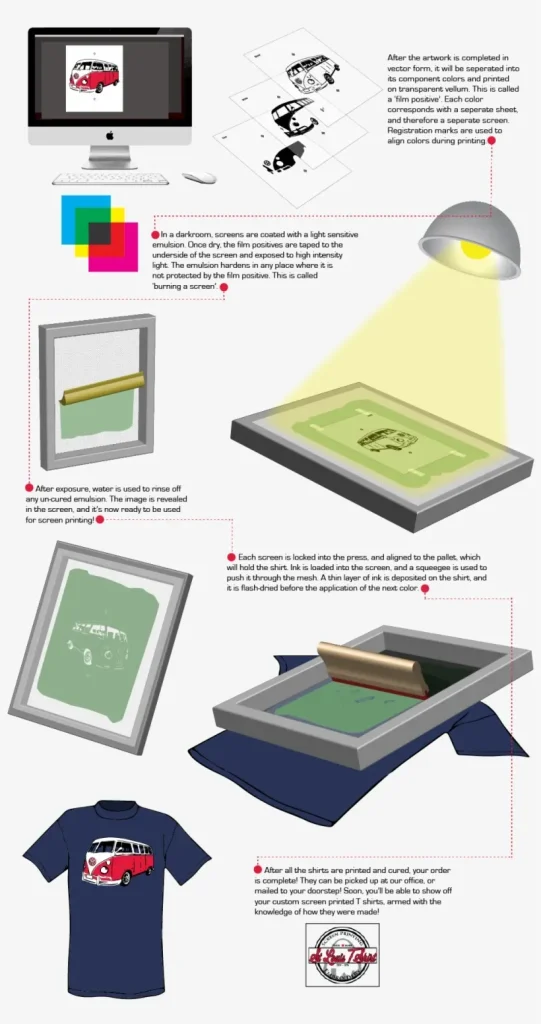
Emulsion chemistry covers the film that becomes the stencil; its formulation determines resolution, washout tolerance, and durability. The emulsion sits on the screen as a light-sensitive layer that will resist ink where blocked by the film positive. The chemistry affects resolution, washout ease, and durability, with modern photopolymers offering precise halftone reproduction while maintaining strong edge definition. The interplay between emulsion chemistry and exposure strategy sets the floor for repeatable results across runs.
Practically, operators control coating thickness, drying conditions, and compatibility with the substrate. A too-thick layer can blur lines, while a too-thin layer risks stencil tearing or pinholes. By selecting emulsions that suit ambient conditions, cure demand, and ink system, you optimize the stencil’s fidelity from one color layer to the next, ensuring predictable prints and easier washout after production.
Emulsion exposure and curing: optimizing light, time, and heat for crisp prints
Exposure and curing are the moments when light and chemistry meet to create a print-ready stencil. Exposure time depends on the emulsion type, film transparency, and mesh thickness; underexposure yields soft washout and weak resolution, while overexposure hardens unwanted areas and dulls detail. Once exposed, the stencil must be cured or dried to lock the emulsion in place, ensuring it can withstand the squeegee’s pressure and multi-pass runs. Emulsion exposure and curing are tightly linked to achieving consistent results across production.
Emulsion exposure and curing are intertwined with ink behavior and substrate. Operators run test strips to gauge density and edge fidelity, then adjust lamp output, distance, and cure temperature for consistency. The goal is a stencil that holds sharp lines at every layer, while the ink cures cleanly on the chosen substrate without scorching or cracking.
Screen printing process steps: from design to finished garment with repeatable results
Screen printing process steps capture the route from idea to finished garment. It starts with design and film creation, where artwork is separated into color layers and transferred to films that guide stencil creation. Understanding this pipeline helps explain why ink selection, mesh choice, and emulsion chemistry matter at every stage.
From screen preparation to curing, each step demands attention to exposure, ink viscosity, and color accuracy. By following the sequence—screen prep, mask and exposure, washout, ink setup, printing, and curing—printers can align registration with multi-color layers and maintain consistent results across run lengths. The discipline of the process steps translates science into reliable production.
Quality control and troubleshooting: a scientific approach to consistent color and adhesion
A quality-control mindset treats screen printing as a living system where material properties and processing parameters interact. A scientific approach to troubleshooting involves controlled experiments: change one variable at a time—such as ink viscosity, mesh tension, or exposure—and observe the effect on print quality. This disciplined method helps you isolate root causes rather than guessing.
Typical issues—blurred edges, weak adhesion, slow drying, or color inconsistency—can stem from substrate mismatch, ink choice, or cure misalignment. By documenting settings, running test prints, and comparing results, you can implement robust fixes. Regularly auditing washfastness and flex performance ensures your outputs hold up under real-world use.
Frequently Asked Questions
In the Science of screen printing, how do you select screen printing ink types for different substrates?
Screen printing ink types include water-based, plastisol, discharge, UV-curable, and hybrid blends. Each ink type has different viscosity, binder systems, and cure temperatures that interact with substrate porosity and hand feel. The right choice depends on the substrate and desired wear, color, and durability. Practical steps include testing ink on swatches, adjusting viscosity for your mesh, and validating cure conditions on the press. Framing ink selection within the Science of screen printing helps optimize color, opacity, and elasticity across substrates.
How does screen printing mesh count affect detail and opacity within the Science of screen printing?
Mesh count determines how much ink passes through the screen and the level of detail achievable. Higher mesh counts produce finer lines and sharper edges but deposit less ink, ideal for detailed graphics; lower counts yield thicker ink deposits for bold, opaque areas. Consider mesh type (polyester vs nylon), thread thickness, and screen tension, all of which influence registration and edge quality. Practical tests across designs help you pick the balance between detail and opacity. In short, screen printing mesh count is a tuning knob you optimize with the Science of screen printing approach.
What role does emulsion chemistry play in stencil quality for screen printing, and how can I optimize it?
Emulsion chemistry governs stencil fidelity and durability in the Science of screen printing. The emulsion type, coating thickness, drying conditions, and compatibility with your exposure process determine edge sharpness and wear resistance. Photopolymer emulsions offer fine detail but require precise exposure control; diazo emulsions can be more forgiving but may trade some resolution. Optimize by matching emulsion to your exposure light, maintaining uniform coating, and testing adhesion after multiple prints. This science-driven tuning reduces pinholes, halos, and stencil breakdown.
How do emulsion exposure and curing influence print sharpness and durability in the Science of screen printing?
Exposure time must balance sufficient hardening of the image areas with minimal hardening of the background, preventing washout or overexposure. After exposure, curing the ink ensures proper adhesion and washfastness, whether by heat, UV, or a combination suitable for the ink type. Use test strips and monitor lamp output to keep exposure consistent across runs. Proper emulsion exposure and curing yield crisper lines and durable prints.
What are the key screen printing process steps, and how does understanding their science improve results?
Typical steps include design/film preparation, screen preparation and coating, masking and exposure, washout and stencil development, ink setup, printing, and curing with quality control. Each step is informed by the behavior of ink types, mesh, and emulsion, so optimizing one step supports the entire print. Aligning color separations, registration, and curing with repeatable procedures improves consistency across runs. Understanding these process steps through a scientific lens improves efficiency and results.
What practical troubleshooting tips does the Science of screen printing offer for issues like halo edges or poor washfastness?
Troubleshooting with the Science of screen printing relies on controlled experiments and careful data logging. For halo edges or blurred outlines, check ink viscosity, mesh count, squeegee pressure, and exposure level—these are common signs of excessive ink, overexposure, or registration drift. If washes fade or inks crack, inspect ink chemistry, substrate compatibility, and cure temperature. Change one variable at a time (for example, adjust ink viscosity or exposure time) and compare results with test strips. A systematic approach yields repeatable fixes and higher quality prints.
| Topic |
|---|
| Ink types: Water-based, plastisol, discharge, UV-curable, and hybrid inks. Key considerations include hand feel, opacity, colorfastness, cure temperature, and substrate compatibility. |
| Mesh and tension: Mesh count per inch determines detail vs. ink deposition; higher counts yield finer detail but less ink, while lower counts increase opacity. Mesh type, thread diameter, and proper screen tension affect edge sharpness and repeatability. |
| Emulsion chemistry: From diazo to photopolymers, emulsion selection and coating control stencil fidelity, washout ease, and durability. Coating thickness, drying, and adhesion influence halftones and print life. |
| Exposure and curing: Exposure time depends on emulsion, mesh, and film transparency; underexposure leads to weak stencil, overexposure hides details. Proper curing ensures ink adhesion and durability, with test strips and consistent lamp output guiding the process. |
| Screen printing process steps: Design/film creation, screen preparation, masking/exposure, washout, ink setup, printing, curing, and quality inspection. Each step applies ink–mesh–emulsion science to achieve repeatable results. |
| Quality control and troubleshooting: Monitor ink consistency, tension, and emulsion wear; use controlled experiments to isolate variables. Common issues include blurred edges, poor adhesion, slow drying, and color drift, addressed with systematic adjustments and testing. |
| Practical optimization tips: Maintain ink-spec logs, choose mesh counts to match design detail and desired opacity, calibrate emulsion coating and drying, and verify exposure with test strips. Environmental control and post-print durability testing further safeguard consistency. |
| Future outlook: Advancements in eco-friendly inks, higher-resolution emulsions, and optimized mesh materials continue to expand substrate compatibility and print quality, while reinforcing the link between art and science in the Screen Printing field. |
Summary
The table above highlights the core components of the Science of screen printing, including ink types, mesh and tension, emulsion chemistry, exposure and curing, process steps, troubleshooting, and practical optimization. These elements collectively drive reliable, repeatable, high-quality screen-printed results.